
WordPress vs. Headless CMS vs CARL
No matter how you toss it or turn it, C.A.R.L users WIN EVERY TIME!
The Problem With WordPress, In Case You Need a Reminder
If you're researching headless CMS platforms, WordPress has already let you down. Maybe it got hacked. Maybe a plugin update destroyed your site on a Friday night. Maybe you got tired of paying for security, backup, caching, and SEO plugins, only to watch them fight each other anyway.
WordPress runs on a model with a structural flaw baked into it. Every page load fires a database query, runs PHP, loads plugins, and assembles HTML from scratch. Every single visit. That runtime is the attack surface. The plugin ecosystem is the open door. Getting hacked was never an if. It was always a when.
So you started looking for alternatives. Someone mentioned headless CMS. Here's what that actually means.
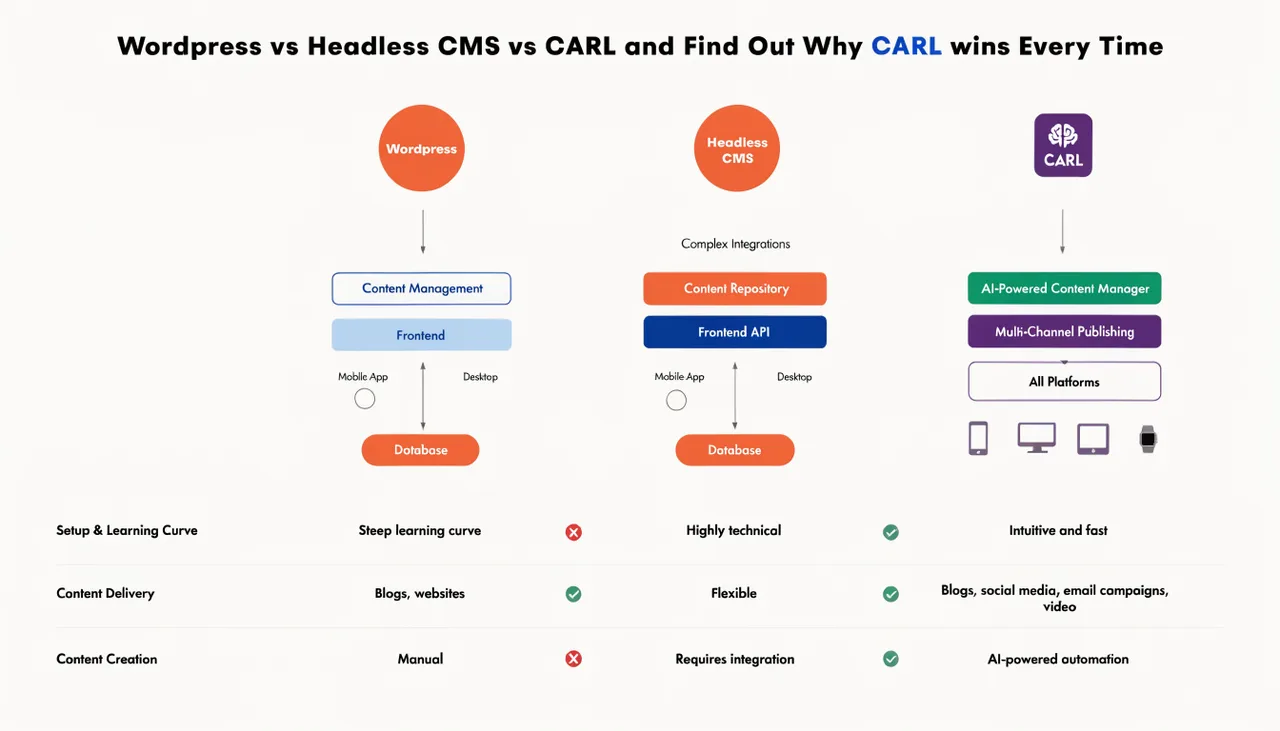
What a Headless CMS Actually Is
A traditional CMS has two parts: the back end, where you manage content, and the front end (the website your visitors actually see). WordPress controls both. They're married to each other.
A headless CMS removes the front end entirely. That's where the name comes from: a body with no head. It gives you a backend for managing content, delivers that content via an API, and stops there. It doesn't build a website. It doesn't render anything in a browser. It hands you raw content data and leaves the rest to you.
You build your own front end separately, usually with React, Next.js, or Vue.js. Your front-end calls the CMS API every time it needs content, assembles the page, and delivers it to the visitor. Contentful works this way. Sanity works this way. Strapi works this way. They manage content. The website is your engineering problem.
Who This Architecture Is Actually For
Headless makes genuine sense in specific situations. Large enterprise teams where content editors, front-end developers, and back-end engineers all work separately and need a clean separation of concerns. Businesses publish the same content across multiple platforms simultaneously (a website, a mobile app, a digital display), where one content source feeds many different outputs. Organizations with dedicated engineering teams that can build, maintain, and host a custom front-end application indefinitely.
If that's your situation, headless might be the right call.
If you're an SEO professional, a web designer, an affiliate marketer, a local business owner, or an indie developer who wants fast, secure websites that rank and generate revenue, headless solves a problem you don't have while creating several you don't want.
What Headless Actually Costs
The marketing around headless CMS platforms is polished, and the demos are impressive. What the demos don't show is the total cost of ownership once you factor in everything the architecture actually requires.
Take Contentful. Their Lite plan (the first paid tier, described as being for "smaller businesses managing a single project") costs $300 a month. $3,600 a year. That buys you a place to store content. It doesn't include hosting for your front-end application, developer time to build and maintain that front-end, the JavaScript framework you need to learn or hire for, or the additional infrastructure for handling API calls at scale.
SEO is its own headache. Headless front ends require significant extra work to handle meta tags, schema markup, canonical URLs, and structured data correctly. That work either costs developer hours or gets done badly.
A realistic headless setup for a serious content site (content management, front-end hosting, developer time, SEO infrastructure) runs several thousand dollars a year at minimum. And when the API goes down, your website goes down with it. Every page on your site has a live dependency on an external service running correctly, every time a visitor arrives.
What CARL Does Instead
CARL is a PHP application platform that generates complete, finished files and writes them directly to your server. More direct and more durable than anything headless or traditional CMS architecture produces.
When you create a page in CARL and click Generate, that file contains everything: content, meta tags, schema markup, navigation, and footer. A real file on your real server.
When a visitor arrives, your server delivers that file. The page is already there, finished, waiting. There's nothing to query, nothing to call, nothing to assemble. A visitor gets a file. The job is done.
CARL also handles what the headless stack leaves for you to figure out. AI-powered schema generation produces complete JSON-LD structured data, Open Graph tags, Twitter cards, and a canonical URL in one click. Affiliate link tracking, email subscriber management, a members area with free and premium tiers, scheduled publishing with automatic sitemap updates, all of it built in. The hosting is standard cPanel shared hosting. The hosting you already have is almost certainly enough.
The include file system goes further. Entire applications (lead marketplaces, booking systems, calculators, custom forms) can be added to any CARL page with a single line of PHP. The CMS and your custom business logic live in the same file structure on your server, which you own.
WordPress vs Headless CMS vs CARL: The Honest Comparison
| Feature | WordPress | Headless CMS (e.g. Contentful) |
CARL |
|---|---|---|---|
| Annual cost (per site) | £500–900/yr hosting + plugins + theme |
$3,600+/yr CMS only (front end extra) |
£527 once unlimited sites, forever |
| Generates real files | ❌ Builds on every load | ❌ API on every load | ✅ Real PHP files on disk |
| External dependency | ❌ Hundreds of plugins | ❌ External API required | ✅ None |
| Security model | ⚠️ Attack surface on every load | ⚠️ API endpoint exposure | ✅ Static file: nothing to attack |
| Hosting required | Managed WP hosting | CMS + separate front end hosting | Standard cPanel shared hosting |
| Built-in SEO tools | ⚠️ Plugin required | ❌ Build it yourself | ✅ AI schema generation built in |
| Affiliate link tracking | ⚠️ Plugin required | ❌ Not included | ✅ Built in |
| Email subscribers | ⚠️ Plugin required | ❌ Not included | ✅ Built in |
| Members area | ⚠️ Plugin required | ❌ Not included | ✅ Built in |
| Scheduled publishing | ✅ Built in | ⚠️ Varies by platform | ✅ Built in |
| Custom application support | ⚠️ Plugin or custom dev | ⚠️ Custom front end dev | ✅ PHP include files |
| You own your data | ⚠️ Tied to host | ❌ Stored on their servers | ✅ Your server. Your database. |
| Unlimited installs | ✅ | ❌ Per-site pricing | ✅ Unlimited sites, one payment |
| Technical skill required | Low–Medium | High: requires JS framework knowledge | Low: plain English interface |
Who Should Choose What
Choose WordPress if...
You need a specific plugin that has no alternative, you're managing a large existing WordPress site you're not ready to migrate, or you have a client who specifically requires it. Go in clear-eyed about the security implications, keep everything updated obsessively, and treat backups as non-negotiable.
Choose a headless CMS if...
If you're a large enterprise publishing content across five or more platforms simultaneously, you have a dedicated front-end engineering team on staff, and $3,600 a year for content management is a rounding error in your budget. If all 3 of those are true, headless architecture is a genuinely powerful approach for your situation.
Choose CARL if...
You want fast, secure, SEO-optimized websites on hosting you already own, without a monthly platform fee, a plugin ecosystem to babysit, or your content data sitting on someone else's servers. Whether you're building one site or fifty, running affiliate content, local business sites, membership communities, or lead generation funnels, CARL is a complete platform for a single one-time payment. Unlimited sites. Unlimited domains. Client work included. Lifetime updates, because the developer runs his own sites on CARL and he's not going anywhere.
The Bottom Line
Headless CMS is a real solution for a narrow, specific use case. The marketing is excellent. The demos are compelling. For the vast majority of people building websites in 2026 (content sites, affiliate sites, local business sites, membership platforms) it adds cost, complexity, and external dependency in exchange for flexibility they'll never actually use.
CARL generates the file. Writes it to disk. Delivers it instantly. You own everything. You pay once. See what's included.