Why CARL Pages Load So Fast
Speed on the web usually comes down to one thing: how much work does the server have to do before it can send anything to the browser? For most CMS platforms, that answer is "quite a lot." For CARL, the answer is "almost nothing."
That difference is not a configuration trick or a hosting upgrade. It's a fundamental architectural choice baked into how CARL works from the ground up.
What WordPress Does on Every Visit
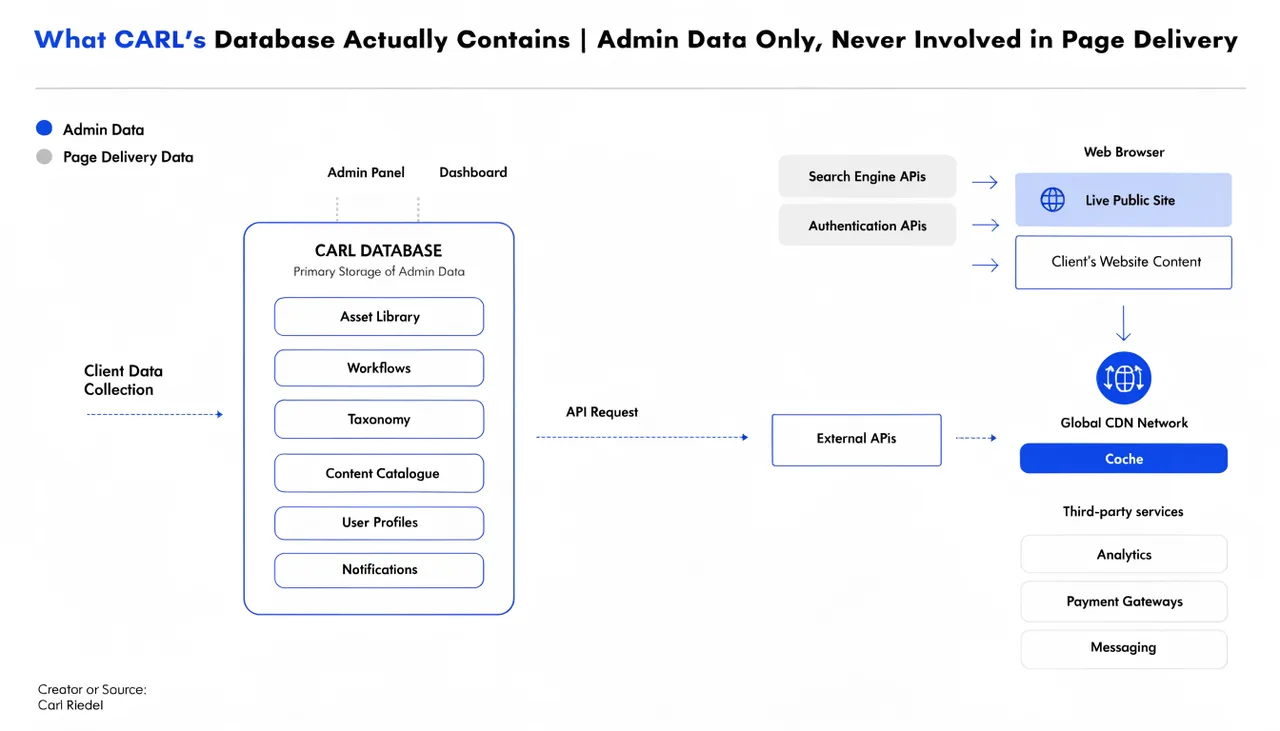
When someone visits a WordPress page, the server starts from scratch. It connects to the database, runs a query to fetch the post content, loads PHP, fires dozens of hooks, executes every active plugin, assembles the HTML, and then finally sends the result to the browser. Every single visit triggers that entire chain.
On a quiet site with fast hosting, this might take 800ms to 1.5 seconds. Add a few more plugins, a shared server under load, or a traffic spike, and that number climbs fast. Caching plugins exist to paper over this problem by storing a pre-built version of the output. Which is, ironically, exactly what CARL does by default.
What CARL Does Instead
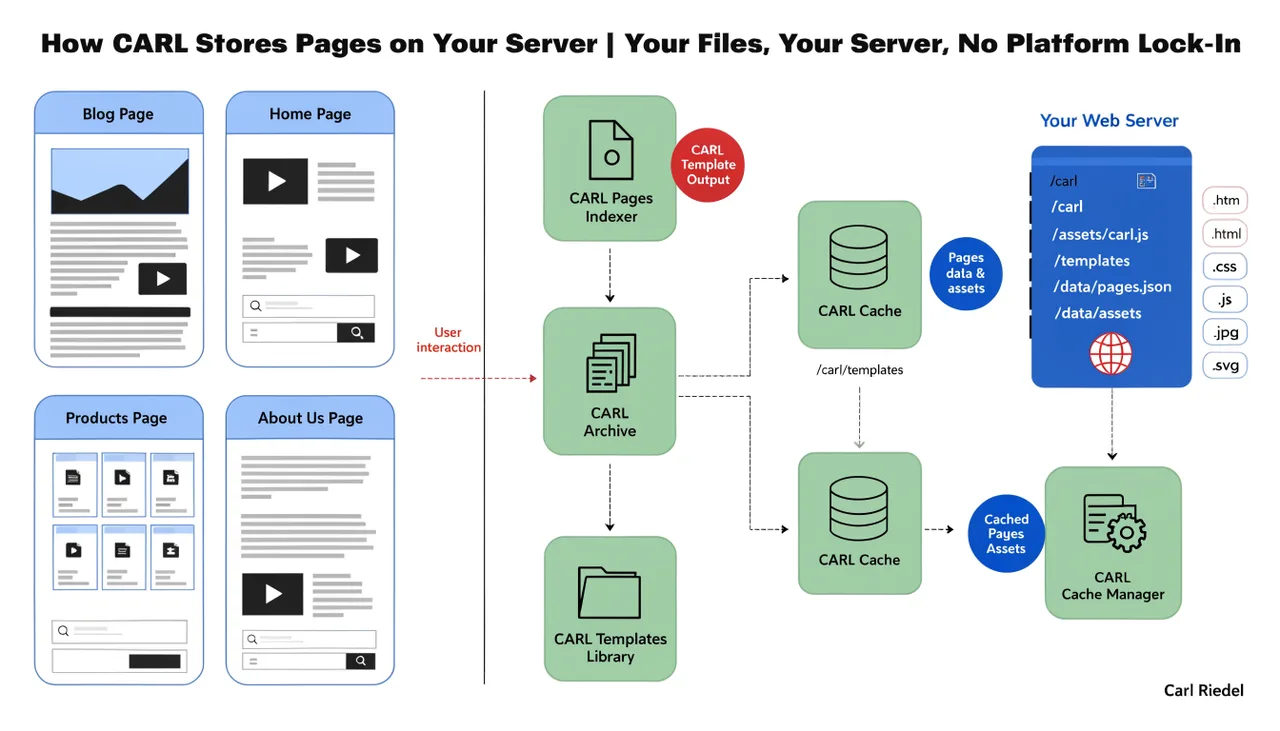
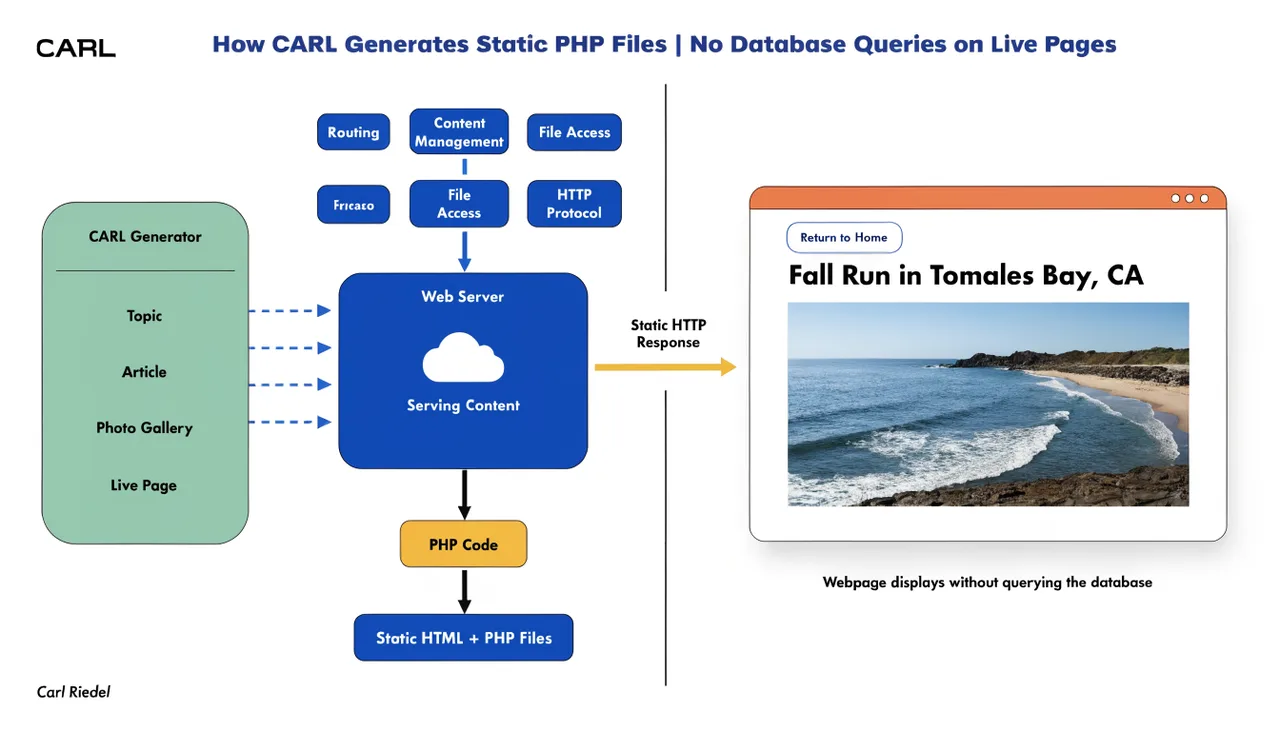
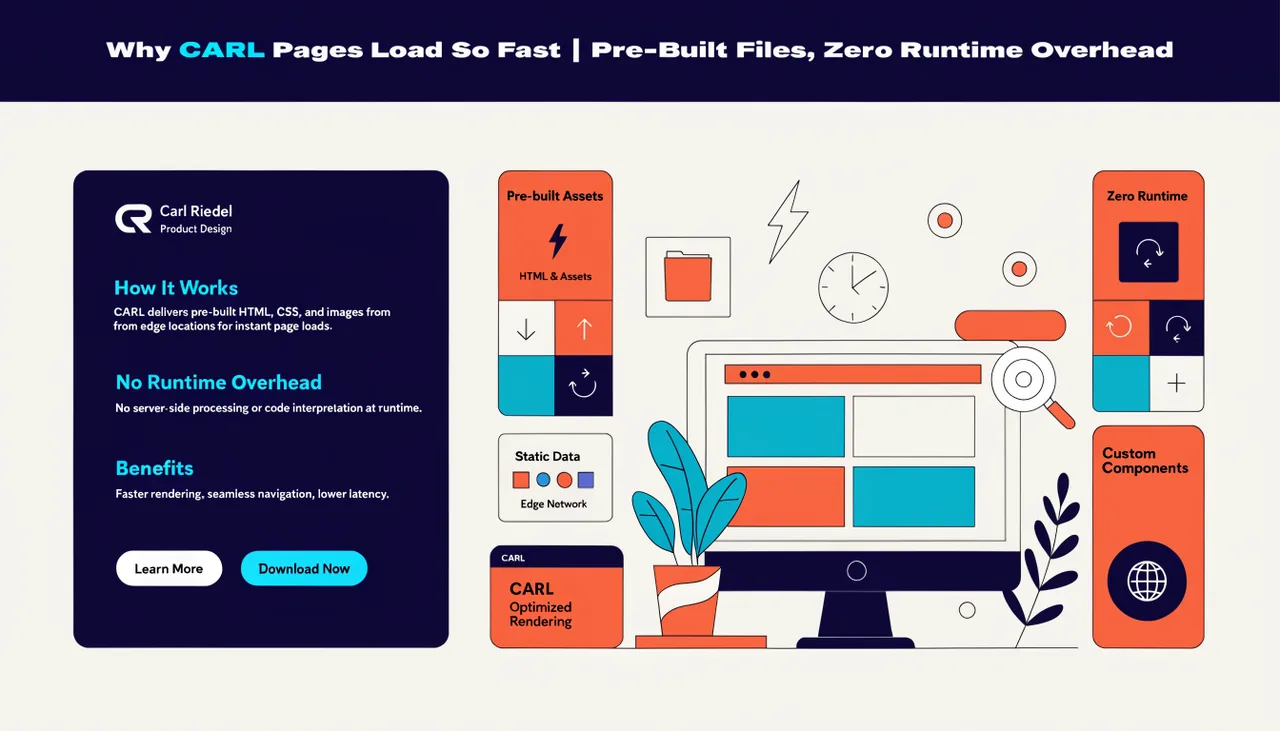
CARL builds the page once, when you publish it, and saves the finished file to disk. When a visitor arrives, the server just hands them that file. No database connection, no PHP execution, no plugin stack. The heavy lifting was done at publish time, not at visit time.
This is what CARL's static file generation produces: a ready-to-serve PHP file that lives in your web root. Your server's job on each visit is trivially simple, and trivially simple jobs are fast.
What "Under a Second" Actually Looks Like
On a standard shared cPanel hosting plan, a CARL page typically delivers its first byte in under 100 milliseconds. Full-page load, including images and assets, takes well under a second for most pages. That's not on a dedicated server with a CDN in front of it. That's on ordinary shared hosting that costs a few dollars a month.
The reason is simple physics. Serving a file from disk is one of the most optimized operations a web server performs. Apache and Nginx have been doing it for decades. Give either of them a static file and they will deliver it faster than any dynamically assembled page can match.
Google Notices
Page speed is a confirmed ranking signal. Core Web Vitals (Largest Contentful Paint, Interaction to Next Paint, Cumulative Layout Shift) are part of how Google evaluates page experience. A slow page doesn't just frustrate visitors; it costs you in the rankings.
CARL pages score well on Core Web Vitals without any additional optimization work. No lazy loading plugins, no minification plugins, no image CDN required to hit a passing score. The baseline is already fast because the architecture eliminates the overhead that slows other platforms in the first place.
No Caching Plugin Required
One of the recurring costs of running WordPress is the caching plugin subscription. WP Rocket, W3 Total Cache, and WP Super Cache exist because WordPress is slow by default and needs help generating static output. You pay monthly to fix a problem that shouldn't exist.
CARL doesn't have that problem. Every published page is already the equivalent of a perfectly cached static file. There is nothing to configure, no cache to warm, no cache to invalidate when you make a change. You publish, the file updates, and visitors get the new version immediately.
Shared Hosting Handles It Comfortably
A common assumption is that fast sites need expensive hosting. With a database-driven CMS, that's largely true. Each visitor puts a load on the database and the PHP interpreter, so traffic spikes translate directly into server strain.
With CARL, traffic spikes are much less of a concern. The server is delivering pre-built files, which is lightweight work. A shared hosting account that would buckle under a WordPress traffic spike will handle CARL traffic without breaking a sweat. You get performance headroom without paying for a VPS or dedicated server.